
Value-Based Care
HLC champions private sector value-based care initiatives and supports federal efforts to drive greater efficiencies in patient care delivery, reduce unnecessary costs, reward collaborative treatment, encourage coordinated care, and improve individuals’ overall health.

The Issue
The U.S. healthcare system is financed predominantly by a fee-for-service (FFS) payment model which compensates providers for the volume of services delivered to patients rather than health outcomes achieved. This model perpetuates misaligned incentives, unnecessary costs, and gaps in patient-centered care. However, public and private-sector initiatives are advancing patient-centered payment models that reward providers for improving health by delivering coordinated, integrated, high-value care.
Policy Solutions
HLC champions a patient-centered approach to healthcare that prioritizes wellness and health, prevents and mitigates chronic diseases, bolsters care coordination, and reduces inefficiencies across the care continuum.
Strengthen Initiatives to Prevent Chronic Disease
Chronic diseases afflict six in 10 American adults, and account for 90% of U.S. healthcare spending. To combat this epidemic, HLC supports prioritizing prevention by improving nutrition, physical activity, and environmental health factors. HLC recommends recognizing long-term budgetary savings, expanding pre-deductible coverage for chronic disease management, advancing interoperable health systems, promoting flexible funding for community-based solutions, and clarifying medical expense definitions in medical loss ratio rules.
Reduce Fraud, Waste, and Abuse (FWA) Through Smart Incentives
Healthcare waste accounts for 25% of total spending and stems from inefficient care delivery, fraud and abuse, and administrative complexity. Strengthening FWA mitigation efforts will reduce unnecessary spending and allow resources to be directed to improve patient care. HLC recommends reclassifying expenses to reduce FWA as quality improvement and enacting the Ensuring Electronic Prescribing for Controlled Substances (EPCS).
Expand Access to Telehealth and Hospital at Home Programs
Telehealth and Hospital at Home flexibilities have benefited Americans nationwide, but private sector organizations are hesitant to invest in the infrastructure these programs require without long-term extensions or permanence. HLC recommends making telehealth flexibilities permanent and extending or making permanent the Acute Hospital Care at Home (AHCAH) Waiver.
Strengthen Incentives for Shared Savings and Accountability
Two-sided financial risk models—where providers share in both the potential savings and the potential losses associated with managing a population’s health—incentivize improved outcomes and cost efficiencies. However, these arrangements require upfront investments, regulatory clarity, and stable incentive structures. HLC recommends establishing a permanent pathway for full-risk Accountable Care Organizations (ACOs), extending the 5% incentive for Advanced Alternative Payment Models (APMs), expanding two-sided incentives across all payers, and reducing barriers to Center for Medicare and Medicaid Innovation (CMMI) model participation.
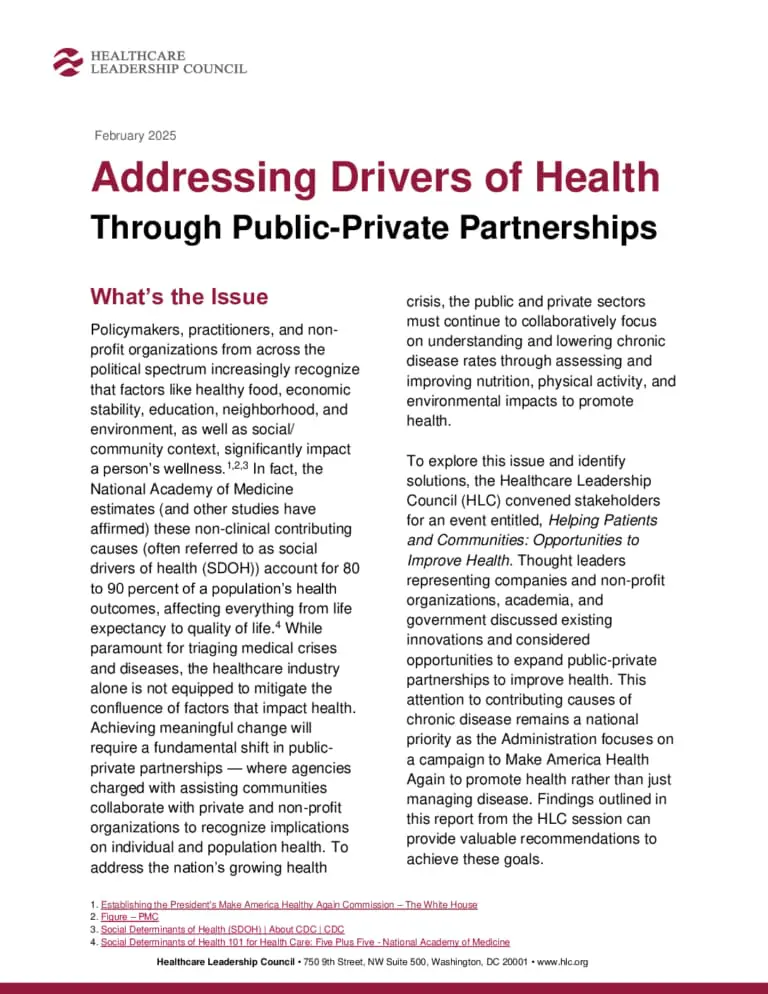
Addressing Drivers of Health Through Public-Private Partnerships
The attention to contributing causes of chronic disease remains a national priority as the Administration focuses on a campaign to Make America Health Again to promote health rather than just managing disease.
HLC convened thought leaders representing companies and non-profit organizations, academia, and government at an event to discuss existing innovations and consider opportunities to expand public-private partnerships to improve health.
Findings outlined in this report from the HLC session can provide valuable recommendations to achieve these goals.
Value-Based Care Letters & Comments
Group letter to CMS opposing proposed remote monitoring restrictions in the 2027 Physician Fee Schedule
HLC also joined a coalition letter urging CMS not to finalize proposed changes to remote physiologic monitoring (RPM) and remote therapeutic monitoring (RTM) in the 2027 Physician Fee Schedule proposed rule that would restrict clinically integrated …
Group letter to the Committee on Education and Workforce urging House passage of S. 2120, the Older Americans Act (OAA) Reauthorization Act
HLC joined the Healthy Aging Coalition in urging the House to pass S. 2120, the Older Americans Act Reauthorization Act, following its bipartisan passage in the Senate. The letter emphasizes the importance of aging-network services, including nutrit…
Group letter to HHS in response to proposed Healthy People 2030 Social Determinants of Health research objective
HLC joined the Healthy Aging Coalition in submitting comments supporting a proposed Healthy People 2030 objective focused on evaluating how referrals to community-based, non-clinical services affect health outcomes. The letter urges HHS to prioritiz…
Value-Based Care News
“Greater transparency will support smarter policymaking” – HLC Leader reacts to advancement of ‘Apples to Apples’ Act
HLC President and CEO Maria Ghazal released the following statement after the House Ways and Means Committee voted to advance H.R. 4093, the Apples to Apples Comparison Act:"As Medicare continues to evolve, it is essential that beneficiaries, policy…
The House Took an Important Step Forward for Value-Based Care. The Senate Should Do the Same.
As Congress enters the final stretch of its legislative calendar, the Senate has a critical opportunity to strengthen value-based care and improve patient outcomes. In late June, the House overwhelmingly passed H.R. 5347, the Health Care Efficiency …
HLC Leader Discusses the Trends Shaping Healthcare’s Future on Becker’s Podcast
Affordability, artificial intelligence, and workforce challenges continue to dominate conversations across the healthcare industry. During a recent appearance on the Becker’s Healthcare Podcast, HLC President and CEO Maria Ghazal shared her perspect…
Explore HLC
HLC is the only group in Washington that unites healthcare CEOs and leaders across all sectors to shape policy that strengthens the system and improves care.

